
Market Evolution and Introduction
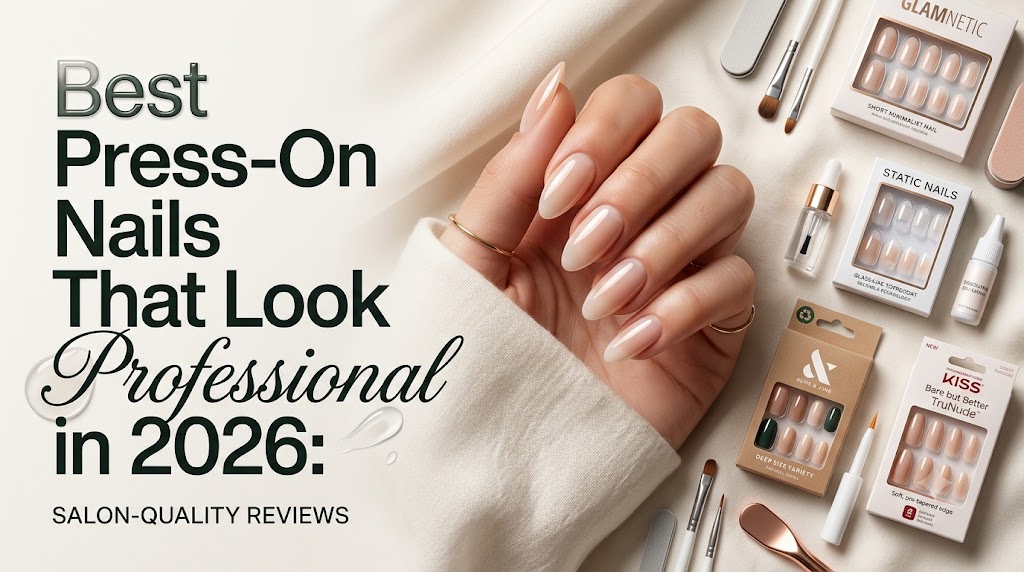
The modern beauty landscape has experienced a massive shift toward luxury optimization and smart personal care spending. Salon quality manicures are no longer confined to high-end boutique establishments, as professional grade artificial overlays have officially closed the performance gap with traditional salon services. Advanced liquid polymer resin formulations and PMMA flexible polymers now allow consumers to achieve flawless, durable extensions at home. This evolution prioritizes nail plate health while offering sophisticated gel X alternatives that withstand the rigors of daily professional life.
Understanding how these advanced materials interact with natural anatomy is the secret to shifting away from cheap, artificial looks and achieving a seamless, high-end finish.
Anatomy of Professional Press On Nails
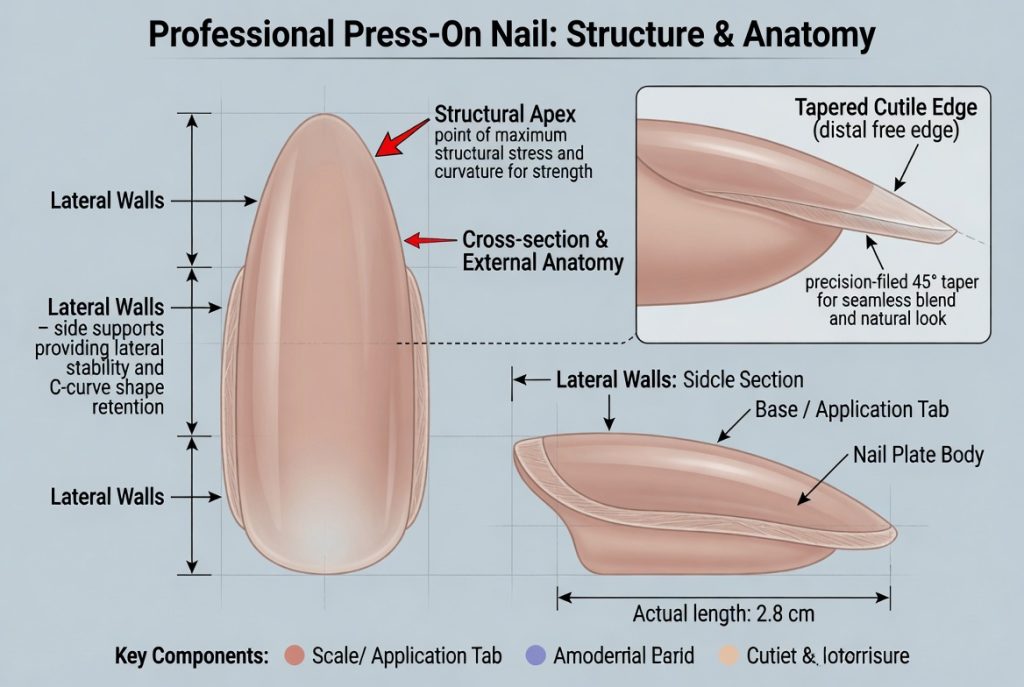
To achieve a look that genuinely replicates a luxury salon service, an artificial extension must meet three strict structural criteria.
- Structural Apex: This is the reinforced central curvature of the artificial plate. It mimics the natural structural arch of a healthy nail, providing the impact resistance necessary to prevent horizontal snapping or bending under heavy typing pressure.
- Tapered Cuticle Base: High-quality extensions feature micro engineered edges that gradually thin out toward the bottom. This allows the material to blend smoothly into the eponychium contour (the cuticle line), eliminating visible ridges and preventing hair or debris from catching at the base.
- Surface Dimension Variety: Premium manufacturers provide expanded size matrix ranges rather than standard generic sizing. Securing full lateral wall (sidewall) coverage without overlapping onto the surrounding soft tissue is essential for both comfort and an authentic look.
Product Performance Reviews and Sentiment Data
Glamnetic Press On Nails
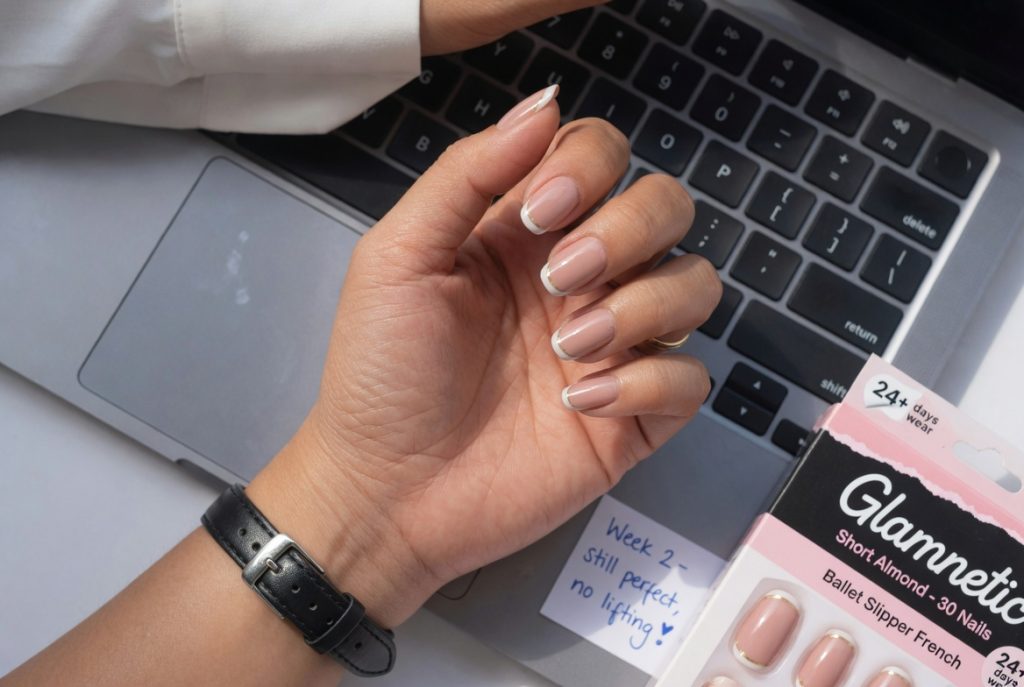
- Core Focus: Corporate environment aesthetics and tip rigidity.
- Verified Google Review Rating: 4.6 out of 5 stars.
- User Sentiment Data: Highly rated for resisting edge chipping and maintaining a reliable waterproof bond. Some consumers with exceptionally flat nail configurations noted that the pre-set curve can feel a bit tight initially.
Static Nails Pop On Manicures
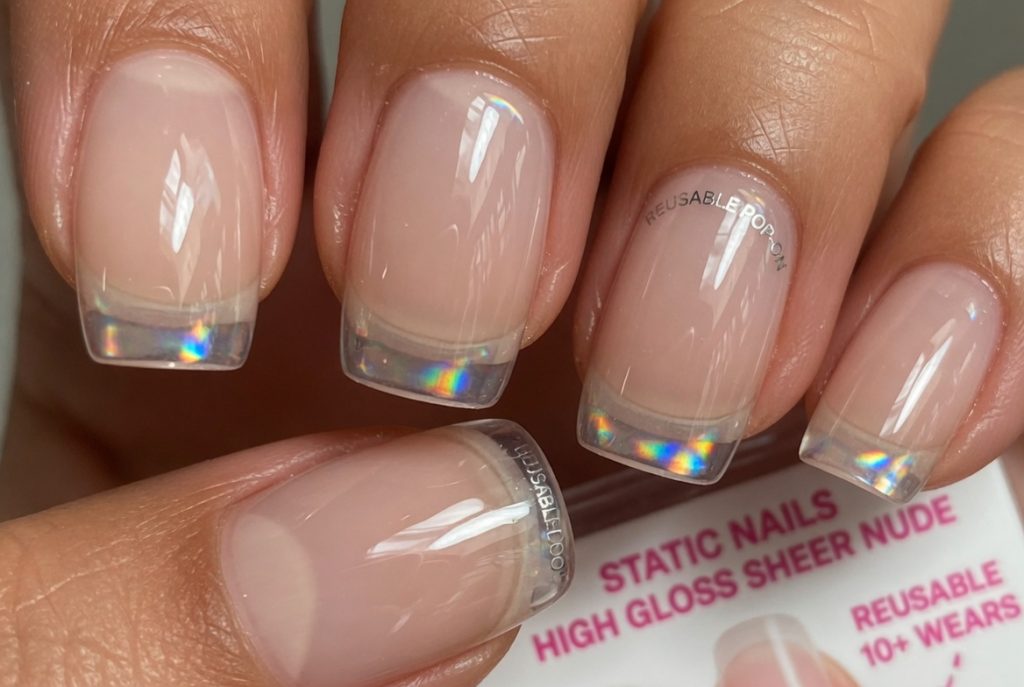
- Core Focus: Reusable high gloss glass coatings.
- Verified Google Review Rating: 4.4 out of 5 stars.
- User Sentiment Data: Universally praised for non damaging removal traits and high-reusability. However, users mention that translucent or sheer variants require exact application dexterity to hide micro bubbles underneath.
Olive and June Press On System
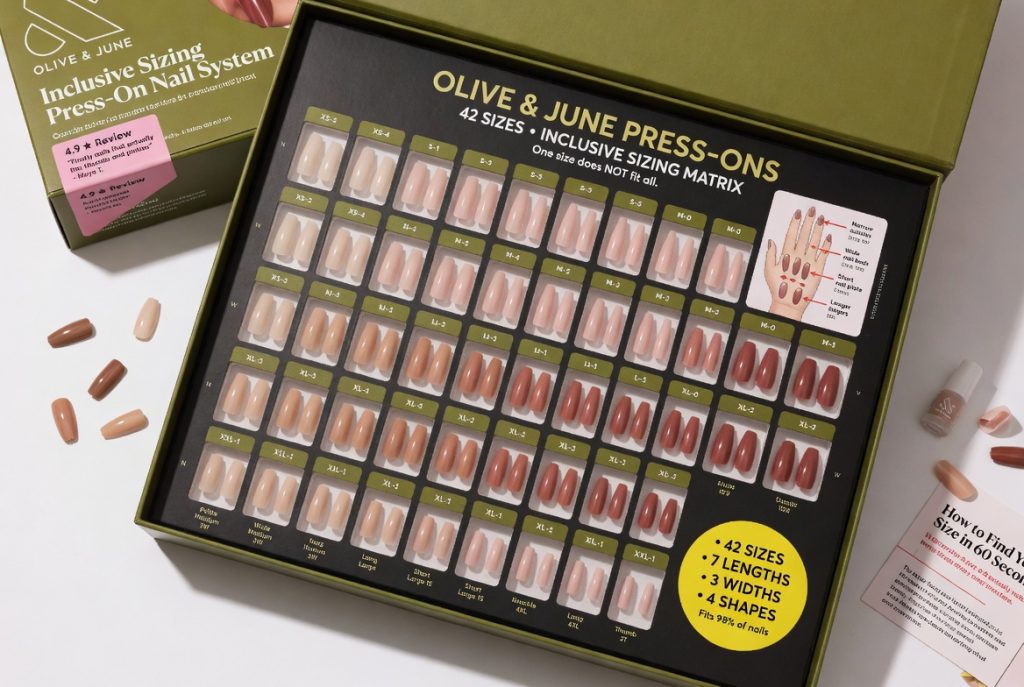
- Core Focus: Custom size matching and short options.
- Verified Google Review Rating: 4.5 out of 5 stars.
- User Sentiment Data: Commended for natural appearance lengths and an incredibly inclusive sizing system. The general style curation favors elegant, conservative color palettes over avant-garde or extreme designs.
KISS Bare But Better TruNude
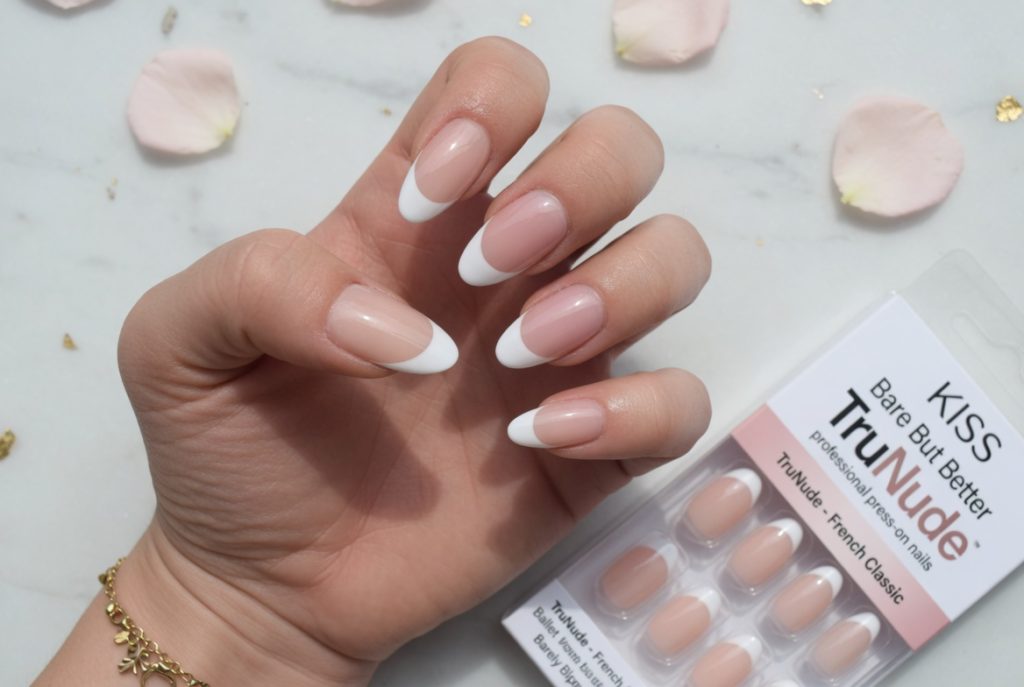
- Core Focus: Seamless skin tone matching.
- Verified Google Review Rating: 4.7 out of 5 stars.
- User Sentiment Data: A dominant mass market preference for flawless translucent blending right at the cuticle line. The only notable drawback is that daily, long term water exposure can shorten the overall wear duration compared to specialty salon brands.
Comparative Product Specifications Matrix
| Brand | Average Wear Lifespan | Primary Advantage | Material Limitation |
| Glamnetic | 10 to 14 Days | Waterproof structural bond with highly rigid tips | Limited selection of extra short lengths |
| Static Nails | 7 to 10 Days | Fully reusable plates with dissolvable adhesive properties | Requires extreme precision to prevent bubble visibility |
| Olive and June | 10 to 12 Days | Expanded sizing matrix using post consumer materials | Designs lean heavily toward minimalist styles |
| KISS TruNude | 5 to 7 Days | Seamless flush cuticle fit at an accessible price point | Lower resistance to prolonged moisture exposure |
Professional Manicure Deployment Toolkit
Achieving a multi week wear cycle requires moving past the basic tools included in retail packaging. A professional setup utilizes targeted solutions to optimize the bonding surface. [INTERNAL LINK HOOK: Step-by-step tool checklist for advanced DIY manicures]
- Pure Acetone: Formulated specifically for removing surface sebum (natural oils), old adhesive residues, and deep moisture contamination.
- Dual Grit Buffer: Utilizing 180 and 240 grit surfaces allows you to gently etch a clean micro abrasive topography (rough surface texture) without thinning the vital natural keratin layer.
- Orangewood Precision Sticks: Traditional, disposable tooling required for clean lateral wall definition and careful cuticle retraction.
- pH Dehydrator Solution: A crucial chemical pre treatment that temporarily alters the surface energy of the nail plate to maximize the cyanoacrylate polymer bond strength.
Longevity Optimization Application Protocol
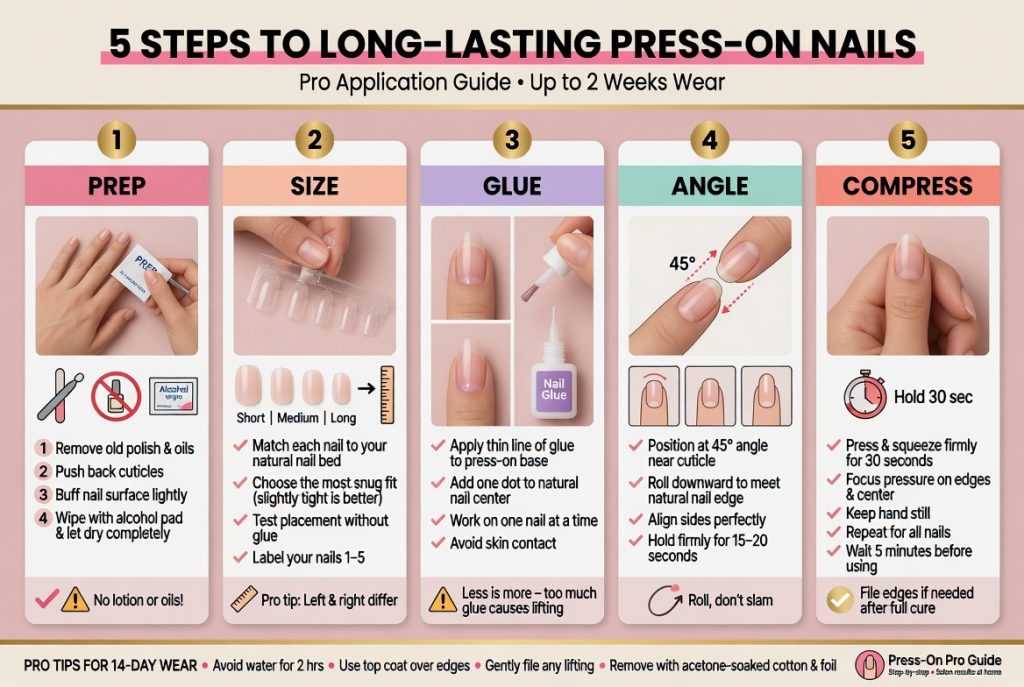
- Sanitize and Dehydrate: Clean the hands thoroughly with antibacterial soap, then apply the isopropyl alcohol or pH dehydrator to eliminate surface moisture and lipids.
- Size Calibration: Match the artificial plates to each individual finger beforehand, ensuring no material overlaps onto surrounding soft tissue or the proximal nail fold (the skin flap at the base of the nail).
- Polymer Adhesive Distribution: Place a precise drop of liquid cyanoacrylate resin onto the center of the natural nail plate and a thin, even layer onto the artificial backing.
- Angular Installation: Lower the press on extension at a precise 45 degree angle starting directly against the cuticle fold, rolling it forward slowly to the free edge to completely expel air pockets.
- Structural Compression: Apply firm, uniform pressure across the entire surface for 30 seconds to allow the monomer to solidify into a flawless, airtight seal.
Frequently Asked Questions and Knowledge Graph Alignment
Do press on extensions cause permanent keratin degradation?
Press-on extensions do not cause permanent keratin degradation (the breaking down of nail protein) when applied and removed using non-invasive solvent-based protocols. Structural damage, severe onycholysis (nail separating from the bed), and traumatic keratin scaling are almost exclusively user-induced by physically ripping or forcing the artificial plate off before dissolving the interfacial adhesive bond.
How do users manage sizing adjustments between standard manufactured dimensions?
Users should prioritize matching the horizontal apex curvature and then file down the lateral nail walls of a larger plate to fit the sidewall parallel alignment perfectly. Choosing an overlay that is too wide leads to immediate eponychium tissue (cuticle) interference and periungual skin displacement (pushing against the surrounding skin), ensuring premature lifting.
What causes green discoloration under artificial enhancements?
Green discoloration, clinically recognized as chloronychia (commonly called “the greenies”), is caused by a bacterial colonization of Pseudomonas aeruginosa multiplying inside stagnant moisture pockets. This localized infection occurs when micro-bubbles form within the liquid polymer layer during installation, creating an optimal anaerobic (oxygen-free) environment for bacterial proliferation.
How do lifestyle factors like frequent water exposure affect cyanoacrylate bond longevity?
Frequent exposure to moisture triggers the hydrolytic degradation (chemical breakdown caused by water) of the cured ethyl cyanoacrylate resin, reducing its ultimate tensile bond strength. Prolonged liquid immersion hydrolyzes the hard cross-linked matrix, creating interfacial moisture failure that requires protective barriers like nitrile gloves to counteract.
What is the difference between PMMA flexible polymers and traditional ABS plastic press ons?
Polymethyl methacrylate (PMMA) flexible polymers offer higher flexural modulus (flexibility strength) and a thinner structural gauge compared to brittle acrylonitrile butadiene styrene (ABS) plastics. This modern compound adapts effortlessly to complex natural nail morphology (shape), reducing spring-back tension against the dorsal nail plate while delivering a completely flush cuticle integration.
How do you prevent press on nails from lifting at the eponychium contour?
Preventing edge lifting requires complete pterygium (the stubborn skin layer attached to the nail) removal and precise proximal nail fold retraction before installing the tapered base plate. Eliminating all dead skin cells and surface lipids ensures the structural adhesive anchors directly onto the clean keratin surface rather than vascular soft tissue.
Can you use a pH dehydrator to increase mechanical adhesion for press ons?
Applying an isopropyl alcohol based pH dehydrator maximizes mechanical adhesion by temporarily extracting deep surface sebum and moisture from the upper nail plate layers. This chemical pre-treatment raises the natural surface energy, creating an optimized, oil-free substrate for the liquid monomer to cure efficiently.
Is acetone safe for removing reusable pop on manicures?
Pure acetone solvents trigger instant thermoplastic deformation (melting and warping) and structural breakdown of the artificial plate, rendering the enhancement completely non-reusable. To preserve the polymer structural integrity for future applications, execute a non-acetone removal protocol using warm water, surfactant liquids (soap), and lipid-replenishing cosmetic oils.
How do you eliminate micro bubbles during the press on application phase?
Eliminate micro-bubbles by using a slow capillary action flow technique, setting the artificial extension at a 45 degree angle against the cuticle fold before rolling it forward to the free edge. This controlled axis roll displacement forces air pockets outward, achieving an airtight, seamless polymer seal.
Can press on nails be applied safely to damaged or peeling natural nail plates?
Applying high-strength resins over an active case of onychoschizia (the medical term for brittle, splitting, or peeling nails) is contraindicated due to the risk of accelerating superficial keratin layer delamination (peeling). The adhesive bond forms an aggressive link with the compromised dorsal nail plate, tearing away weak structural sheets during removal.
What is the ideal grit level for buffering the natural nail before adhesive application?
An abrasive grit specification of 180 to 240 is ideal for etching a clean micro-abrasive topography without causing traumatic thinning of the natural nail matrix. Coarse salon files should be entirely avoided as they strip critical protective layers, compromising the structural substrate required for stable adhesion.
How do you protect the lateral nail walls from chemical irritation during application?
Protect the lateral nail walls by confining the cyanoacrylate drop to the central longitudinal axis of the natural plate to prevent sideways compression overflow. Restricting the volume of liquid adhesive prevents chemical overflow into the lateral sulcus (the grooves on the sides of your nail), eliminating the risk of localized periungual erythema (redness around the nail edge) or chemical paronychia (skin inflammation).
Why do some press on nails feel painful or tight right after application?
A tight or throbbing sensation indicates a severe transverse curvature mismatch between the rigid pre-formed plate and the flat natural nail morphology. This architectural discrepancy induces a constant upward pulling force on the nail bed, resulting in localized vascular compression (squeezed blood vessels) and temporary tissue stress.
Can you apply a UV gel top coat over pre formed artificial nails to extend wear?
Applying a photo-initiator driven UV gel top coat over pre-formed extensions is highly effective for enhancing surface abrasion resistance and avoiding edge wear. The factory glossy surface must be mechanically etched (lightly scratched) beforehand with a fine buffer to create the mechanical tooth needed for oligomer cross-linking (the gel bonding process).
How do adhesive tabs compare to liquid cyanoacrylate resin for professional use?
Pressure-sensitive adhesive (PSA) tabs offer excellent short-term shear strength for immediate 48 hour wear, whereas liquid cyanoacrylate resin provides structural monomer polymerization engineered for a two-week wear lifecycle. Tabs protect the underlying nail matrix from chemical sensitivity but lack total resistance to high structural loads.
How often should press on enhancements be completely removed to assess nail plate health?
Press-on extensions must be completely removed every 14 days to complete a comprehensive subungual (under the nail) inspection and monitor ongoing nail plate health. Extended wear cycles without regular removal allow micro-infiltration pathways to develop unnoticed, hiding potential fungal or bacterial setups from view.
What should you do if an artificial nail lifts but does not detach completely?
Any partially detached artificial enhancement must be entirely removed, sanitized, and reinstalled rather than patched with a fresh drop of resin along the open edge. Layering new adhesive over a lifted border traps existing atmospheric moisture and environmental particles, encouraging retrograde bacterial migration (bacteria crawling backward) beneath the plate.
How do you file short style press ons without breaking the structural apex?
File short shapes by executing a strictly unidirectional (one-way) filing vector across the free edge while supporting the parallel lateral walls with your fingertips. Back-and-forth sawing introduces microscopic stress cracks into the polymer framework, creating stress concentration points that cause premature edge delamination (chipping).
Are modern salon quality press ons safe for individuals prone to contact dermatitis?
Modern pre-formed polymer extensions are completely inert and safe, but the liquid bonding primers can trigger methacrylate hypersensitivity (allergic reactions) if spilled on bare skin. To minimize the risk of allergic contact dermatitis, ensure zero uncured monomer contact occurs with the surrounding periungual skin folds.
How do you properly store reusable press on extensions between applications?
Store reusable polymer enhancements inside an airtight, dust-free organizer box configured for active photodegradation mitigation (preventing light damage) and UV shield protection. Ambient heat and solar radiation cause significant polymer memory distortion (warping) and fading of the top coat finish over time.
Definitive Industry Verdict and User Profile Matching
- High Frequency Typing Profiles: Glamnetic provides the necessary tip structural reinforcement and rigid apex design to endure non-stop keyboard use without flexing or splitting.
- Nail Health Prioritization: Static Nails delivers clean, non-destructive removal pathways with minimal matrix stress, making it perfect for temporary wearers or those with weaker natural bases.
- Natural Aesthetic Targets: Olive and June accommodates shorter, narrower natural nail beds flawlessly with its extensive, anatomically focused size matrix.
