
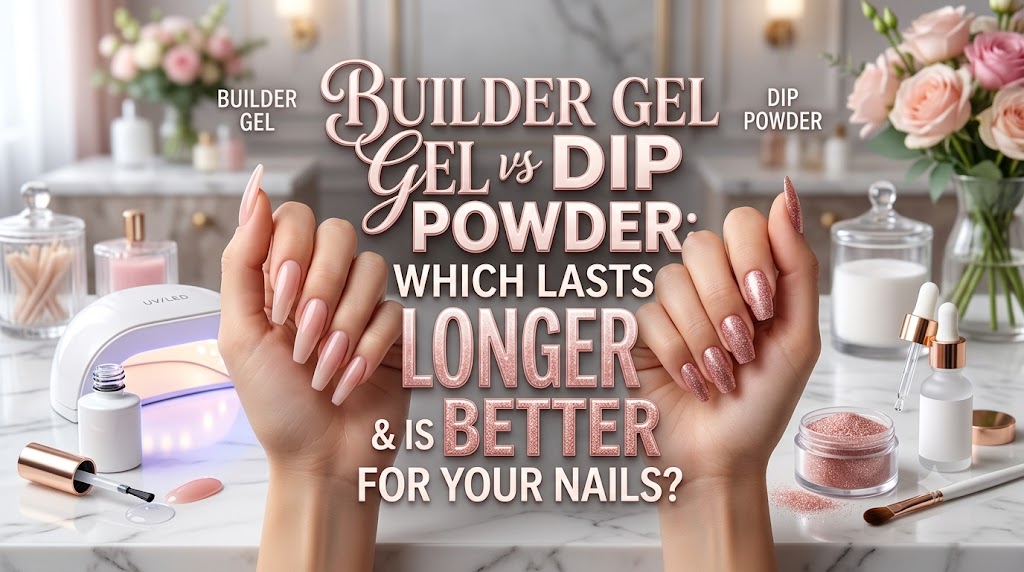
Picture this. A client walks into a bustling salon, sets down a heavy canvas bag, and lets out a massive sigh. She has a week full of keyboard typing, gym sessions, and maybe some heavy backyard gardening ahead of her. She stares at the colorful menu board and asks the classic question every veteran nail tech hears at least three times a day: “Should I get builder gel or dip powder? I just need something that absolutely will not chip by Tuesday.”
If you are trying to figure out your next set, or if you are a salon owner trying to guide your clients, this is the ultimate dilemma. Traditional polish is not even in the conversation anymore. We are talking about the two true heavyweights of the modern nail scene. But while both give you weeks of gorgeous wear, they behave entirely differently under pressure. Let’s break down the actual reality behind both systems without the usual marketing fluff.
What is Builder Gel?
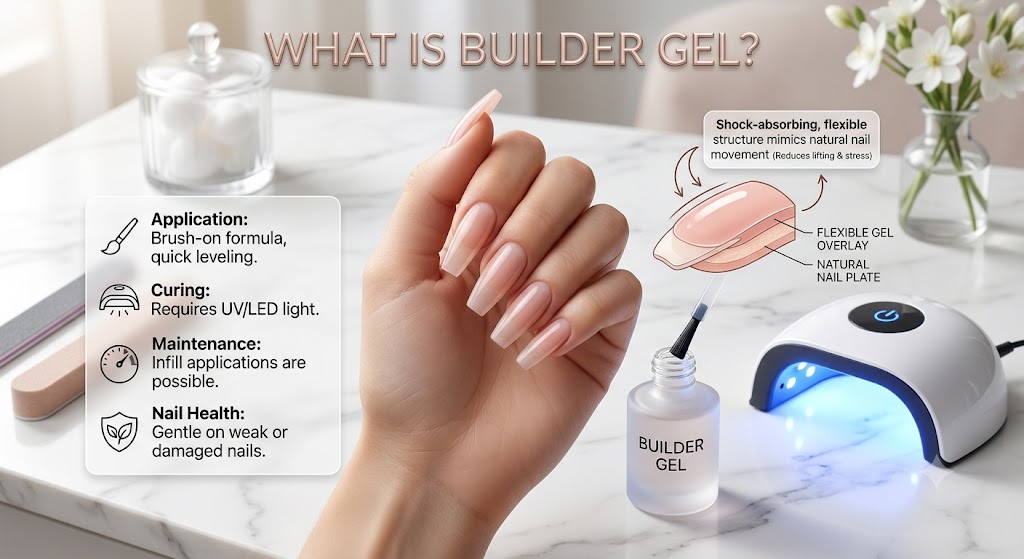
Walk into any high-end boutique salon right now and you will hear everyone talking about BIAB, which is just short for Builder in a Bottle, or builder gel. It is a thick, high-viscosity gel used to create strength, structure, and shape on the natural nail plate.
Here is the magic element: flexibility. Think of it as a mechanical shock absorber. When you accidentally bang your thumb against a car door or a kitchen counter, builder gel moves with your hand. It bends slightly alongside your natural nail plate instead of snapping off or cracking under pressure.
The biggest perk I always highlight to people is the infill advantage. You do not have to melt your fingertips in harsh acetone every three weeks. A skilled tech will simply file down the top color layer, fill in the new growth gap near your cuticle, rebalance the structure, and you are good to go. It saves your natural nails from that constant, drying chemical cycle.
What is Dip Powder?
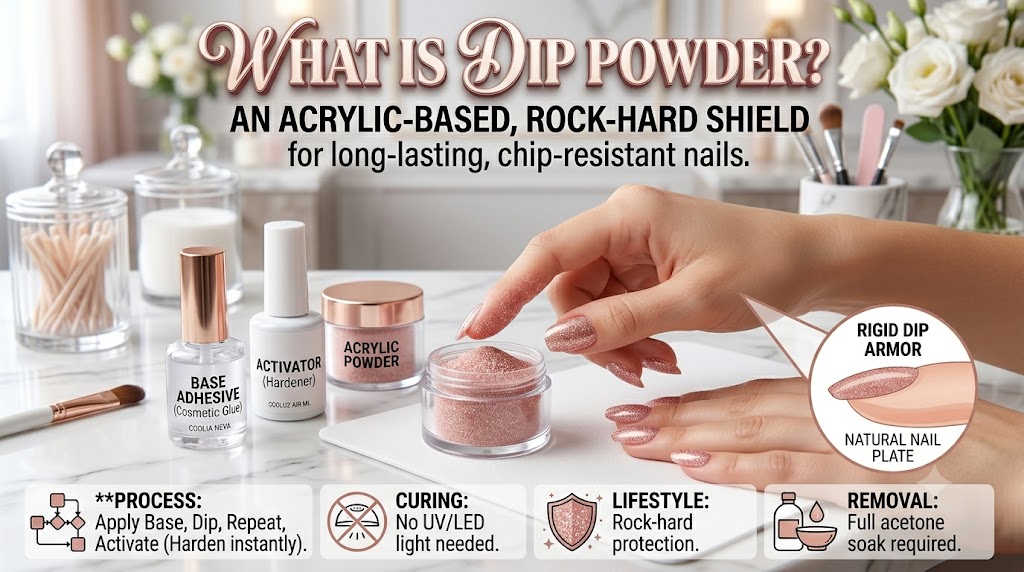
Dip powder takes a completely different route to durability. Think of it as a hard, protective suit of armor for your hands. The process uses a base coat that is essentially a medical-grade cosmetic glue, known in chemistry terms as a cyanoacrylate resin, paired with a finely milled acrylic powder. You paint the base, dip the finger into the powder, apply an activator, and repeat.
The result is an incredibly solid, concrete-hard layer over short to medium natural nails. It reinforces the nail beautifully. But every shield has a weak point. For dip, that weak point is its total lack of flexibility.
Because it is highly rigid, a sharp, sudden impact can cause the whole extension to crack or pop right off your nail bed. Also, maintenance means starting from scratch every single time. There is no such thing as a quick dip fill. You have to scrape, file, and completely soak it all off in heavy acetone before putting a new color on, which can gradually thin your nail plate over time if the tech is rushing the process.
The Longevity Showdown: Which One Actually Lasts Longer?
Let’s talk numbers because everyone wants to get their money’s worth. Honestly, if we are looking at pure calendar days, it is a technical tie. Both systems comfortably hit the 3 to 4-week mark without breaking a sweat.
But how they get to that fourth week depends entirely on your lifestyle. Dip powder easily wins the trophy for raw surface hardness and scratch resistance. If you work with files, boxes, or tools, dip holds up like iron.
On the flip side, builder gel is the clear winner if your hands are constantly submerged in soapy water or if you are typing at lightning speed all day. Water makes natural nails expand and contract. Because builder gel mimics that natural movement, it resists lifting around the edges much better than a rigid dip layer would.
Nail Health Analysis: Which System is Safer?
Time for a professional truth bomb that I tell every single person who complains that a certain product ruined their hands: nail products do not inherently ruin nails. Rushed applications and aggressive, forced removals do. If a tech uses a heavy-handed electric file or pries a lifted nail off with a plastic tip, your natural nails are going to look like thin paper.
That being said, builder gel takes the crown for long-term health. The ability to continuously do infills means your natural nail plate stays protected underneath, away from regular chemical exposure.
Dip powder can absolutely keep you from biting your nails or breaking them short term. However, that repetitive, aggressive scraping and deep acetone soaking required every single month will gradually dry out a fragile nail bed if it is not handled by a patient professional.
The Head-to-Head Matrix
Here is a quick, straightforward breakdown of how these two options stack up when compared directly.
| Feature | Builder Gel | Dip Powder |
| Average Lifespan | 3 to 4 weeks | 3 to 4 weeks |
| Flexibility | High, moves with the natural nail | Low, rigid and firm structure |
| Curing Process | Requires a UV or LED Light lamp | No UV light needed, dries with an activator |
| Nail Art Capabilities | Unlimited, perfect for 3D art and charms | Limited, best for solids, glitters, and ombré |
| Maintenance Style | Convenient infills and rebalancing | Full soak-off and reapplication every visit |
| The Biggest Pros | Lightweight, natural feel, great for growth | Rock-hard shield, protects against biting |
| The Biggest Cons | Can cause a brief heat spike under the lamp | Can look bulky if applied too thickly |
The Ultimate Client Selector Checklist
Still sitting on the fence? Let’s make this simple. Read through these points and see which side fits your daily routine.
Choose Builder Gel if:
- Your natural nails are thin, peeling, or bend easily when pressed.
- You are obsessed with trendy nail art, encapsulated glitter, or 3D chrome details.
- You want to minimize the amount of time your hands spend soaking in acetone bowls.
- Your job or hobbies involve your hands constantly being wet.
Choose Dip Powder if:
- You have a stubborn habit of picking or biting at your polish.
- You are sensitive to or prefer to avoid UV or LED curing lights entirely.
- You prefer a very solid, firm feel on short to medium-length nails.
- You love classic solid colors, rich nudes, or basic glitter fades.
Google Review Insights & Common Pitfalls
If you look closely at Google reviews for local nail salons, you will spot a very distinct pattern regarding client complaints.
When people leave a one-star review after a dip powder appointment, they almost always complain about their nails looking way too thick, chunky, or cracking across the middle within a few days. That is rarely an issue with the powder itself; it is a technician issue. It happens when a tech rushes the application, dips at the wrong angle, or skips the proper filing steps to smooth down the bulk.
For builder gel, the negative reviews usually complain about lifting at the cuticle line after just a week. This almost always points to improper prep work. If a technician leaves invisible cuticle skin on the nail plate, or if a client has naturally oily nail beds and the tech skips a proper dehydrator, the gel simply cannot bond correctly.
Frequently Asked Questions
Q: Can you switch from dip powder to builder gel at your next appointment?
A: Yes, you can absolutely switch from dip powder to builder gel during your next salon visit. However, your technician must completely soak off the existing dip powder first to inspect your nail bed health before applying the new gel layer. You cannot simply fill over a dip set with gel because the products will not bond correctly.
Q: Why does builder gel sometimes cause a burning sensation under the lamp?
A: The burning sensation under a UV LED lamp is known as a heat spike, which happens because gel releases heat as it polymerizes into a solid state. This usually occurs if the product is applied too thickly or if your natural nails are already thinned out from poor manual removal. Professional lamps with a low heat mode can slow down this process to keep you comfortable.
Q: Is dip powder genuinely worse for your natural nail plate than gel?
A: Dip powder itself does not inherently damage your natural nail plate. The real risk to your nail health comes from the aggressive scraping and repetitive acetone soak required during every single removal process. Because builder gel allows for consecutive infills, it bypasses that constant chemical exposure.
Q: How can a client prevent their dip manicure from lifting at the edges early?
A: Meticulous cuticle prep and proper nail dehydration before application are the absolute keys to preventing early lifting. Avoiding heavy water exposure or harsh cleaning chemicals during the first twenty four hours also protects the adhesive bond. If your tech skips the primer or leaves invisible skin on the nail plate, lifting is almost guaranteed.
Q: Which system is more cost-effective for long-term salon maintenance?
A: Builder gel is generally more cost-effective over time because it allows for quick and affordable infills. Instead of paying for a full removal and reapplication every single visit like you do with dip powder, you only pay for the new growth to be rebalanced. This saves both salon time and money over a six month period.
Q: Can builder gel be used to extend nail length like acrylics?
A: Yes, builder gel can easily create short to medium length extensions using paper forms or plastic tips. It provides a lightweight alternative to traditional acrylics while maintaining excellent durability and a more natural feel. However, for extreme, extra long stiletto shapes, traditional acrylic liquid and powder still offer superior rigid support.
Q: Is it safe to apply regular gel polish on top of a dip powder base?
A: Applying regular gel polish over a finished dip powder base is perfectly safe and actually very common in professional salons. It gives you access to a wider variety of trendy colors and intricate nail art options while utilizing the extreme strength of a dip foundation. Just ensure the dip surface is properly buffed and wiped clean before the gel top coat or color goes on.
Q: How long should you wait between getting dip powder or builder gel sets?
A: You do not need to take a break between sets if your enhancements are applied and removed correctly by a professional. Your nail plate is made of dead keratin cells, meaning it does not actually breathe as long as the underlying matrix remains undamaged. Breaks are only necessary if a technician has over filed your nails down to a painful, paper thin state.
Q: Does dip powder require a UV or LED light to dry?
A: No, traditional dip powder does not require a UV or LED lamp to cure. The system hardens through a chemical reaction triggered by a topical liquid activator, making it an excellent option for clients who want to avoid light exposure completely. Always check with your tech though, as some modern hybrid brands use a gel top coat that requires a quick zap under a lamp.
Q: Can you fill a builder gel manicure at home or should you visit a salon?
A: It is highly recommended to visit a professional salon for your builder gel infills to avoid trapped moisture and subsequent infections. Rebalancing the apex of a grown out nail requires advanced e-file skills and precise product placement. Doing it poorly at home can lead to pocket lifting, which creates a breeding ground for bacteria.
Q: Why does dip powder sometimes crack down the middle after a few days?
A: Dip powder manicures usually crack because the product was applied too thinly or the activator liquid failed to penetrate all the layers. Without the proper structural thickness, the rigid acrylic polymer cannot withstand the daily pressure placed on your hands. It can also happen if the technician skips the vital reinforcement steps on your nail tips.
Q: Can you use builder gel to repair a torn or cracked natural nail?
A: Yes, builder gel is an excellent tool for patching up split, torn, or cracked natural nails. A small drop of gel acts as a structural bridge, holding the broken pieces together securely while the natural nail safely grows out. Many clients use a thin overlay of builder gel specifically to protect a weak nail that routinely splits in the same spot.
Q: Is builder gel or dip powder better for chronic nail biters?
A: Dip powder is generally better for severe nail biters because it creates an incredibly hard, unchewable shield over the free edge. The rock hard acrylic texture completely discourages picking and biting, giving the underlying nail a genuine chance to recover. Builder gel works beautifully once the nails have grown out past the fingertips and need flexible strength.
Q: How do you properly remove builder gel without ruining your nail bed health?
A: To protect your nail bed health, builder gel should be carefully filed down using a professional e-file, leaving a very thin protective base layer intact. Unlike soft gel polish, many professional builder formulas do not break down easily in a standard acetone soak. Filing away the bulk of the product prevents you from scraping the sensitive natural nail plate underneath.
Q: Does dip powder have a strong chemical smell like traditional liquid monomer?
A: No, dip powder systems are virtually odorless because they do not utilize an ethyl methacrylate liquid monomer. The base adhesive behaves more like a fast drying cosmetic glue, making the salon experience much more comfortable for scent sensitive clients. It delivers the strength of acrylics without filling the entire salon with heavy fumes.
Q: Can builder gel cause an allergic reaction on the surrounding skin? A: Builder gel can cause contact dermatitis if uncured, liquid product repeatedly touches the skin over a prolonged period. This risk is easily mitigated by choosing a meticulous technician who practices clean application and ensures a complete cure under a quality lamp. Always wash your hands immediately if wet gel accidentally floods your cuticles before curing.
Q: Why do my dip nails look bulky and thick around the cuticles?
A: Bulky cuticles happen when a technician applies the base resin too close to the skin line without tapering the layers properly. Proper dip application requires stepping the product back slightly from the cuticle with each dip to create a smooth, natural slope. If it looks like a thick ledge, your tech skipped the necessary flush filing step near the skin.
Q: What is the difference between structure gel, hard gel, and builder gel?
A: Hard gel cannot be soaked off with acetone at all and must be filed away entirely, whereas many modern builder gels can eventually be soaked off with patience. Structure gel is typically a thinner, more flexible overlay used solely for surface strength on short nails. Builder gel has a much higher viscosity, allowing techs to sculpt extensions and create a pronounced structural apex.
Q: Can you go swimming or use hot tubs with a fresh builder gel set? A: You should generally avoid prolonged exposure to hot tubs or pools for the first twenty four hours after application. While builder gel is highly water resistant, excessive heat and chemical moisture immediately after your appointment can compromise the initial adhesive bond. Once fully settled, it handles swimming much better than rigid systems.
Q: How do you fix a lifted edge on a dip powder manicure safely? A: Never try to glue down a lifted edge at home because you can trap moisture and bacteria underneath, leading to nail infections. The only safe fix is to head back to your salon to have the lifted section filed away and properly repaired. If you cannot get to a salon immediately, file the lifted edge down gently with a hand file to prevent it from catching and tearing further.
The Final Verdict
At the end of the day, choosing between builder gel and dip powder comes down to what your hands need right now. If your nails are weak, damaged, or you live for intricate nail art, builder gel is worth every penny for its flexibility and infill capabilities. But if you want an absolute iron fortress over your natural nails and want to skip the UV light entirely, dip powder remains a fantastic classic. Talk to your tech, look at your lifestyle, and pick the system that works with your hands, not against them.
